
Why Alignment Feels Different Than Effort
After seeing how effort can reinforce patterns…
And how forcing change can create resistance…
A natural question begins to form:
If effort isn’t the answer… then what is?
This is where alignment begins to make sense.
Not as a concept.
But as an experience.
What this feels like in real life
Something shifts… and things start to make sense.
You stop second-guessing every step.
You move forward… and it feels steady instead of forced.
In those moments, it doesn’t feel like you figured something out.
It feels like things are lining up.
But look closely.
The way you’re seeing, feeling, and responding is starting to work together.
This builds directly on what happens when you stop forcing everything.
Because once pressure is removed, something else becomes noticeable.
And that “something else” is often alignment.
Related: Why force and clarity feel different.
What alignment actually is
Alignment is not something you create by force.
It is something you recognize when the way you are seeing, feeling, and responding begins to work together.
There is less internal conflict.
Less tension.
Less resistance.
Things begin to make sense in a different way.
Not because you are trying harder.
But because something has shifted.
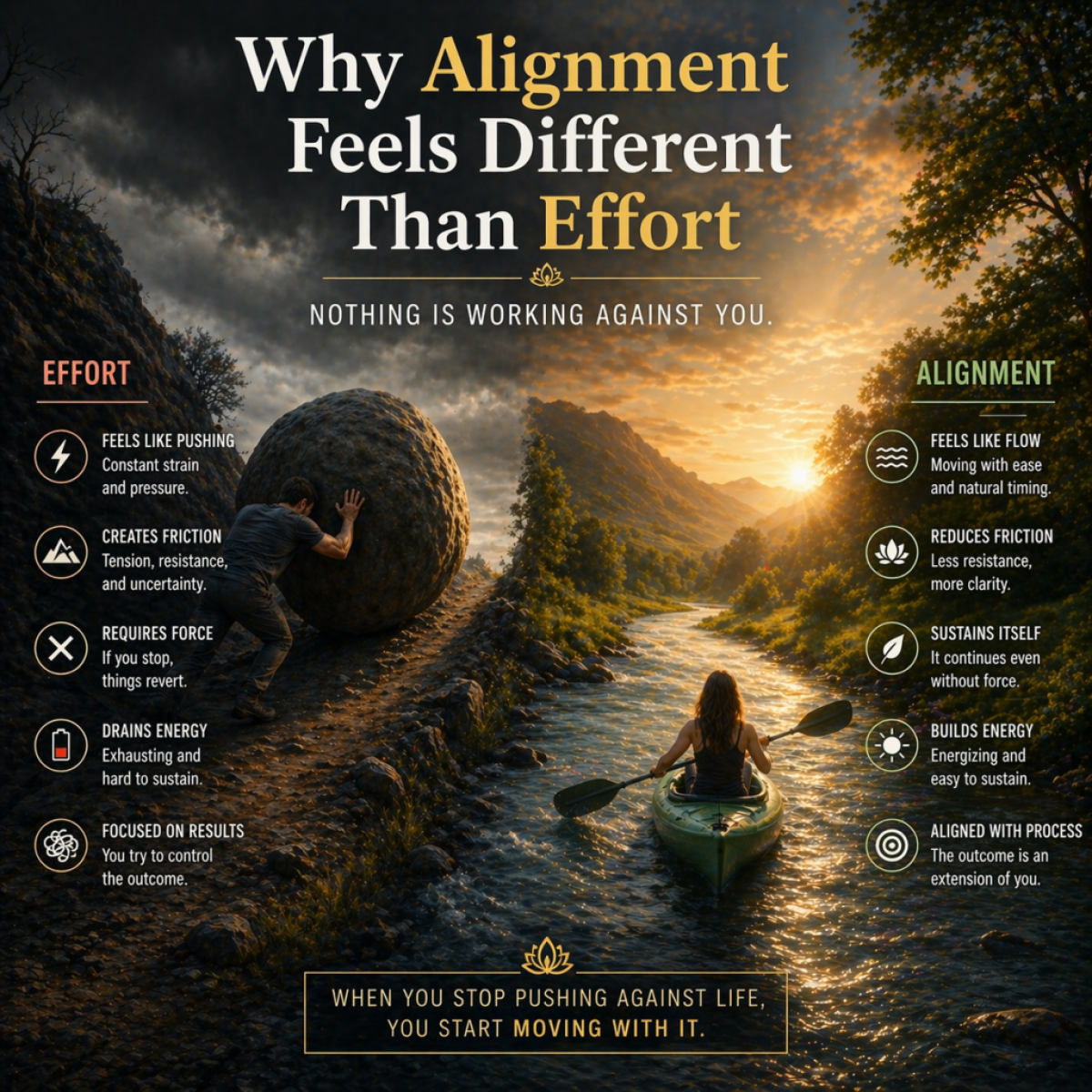
Why alignment feels different than effort
Effort feels like pushing.
It requires continuous input.
If you stop pushing, things often revert.
Alignment feels different.
It feels like things are moving with you instead of against you.
There is still action.
But the action feels natural.
Less forced.
More consistent.
This is why alignment is often described as feeling easier— even when they are doing just as much.
Why effort creates friction
When effort is applied against a pattern that hasn’t shifted, it creates friction.
You feel that friction as:
- Tension
- Resistance
- Uncertainty
This is not a failure.
It is feedback.
It is showing you that something deeper has not yet changed.
Related: Why Forcing Change Doesn’t Work
Why alignment reduces friction
When alignment is present, friction decreases.
Not because nothing is happening.
But because the system is no longer working against itself.
Your perception supports your response.
Your response supports your direction.
This creates a sense of flow.
Even in situations that require effort.
How alignment changes action
In effort-based action, you are trying to produce a result.
In alignment-based action, the result is an extension of how you are relating to the situation.
This changes everything.
Because instead of forcing outcomes, you are allowing them to emerge from a different starting point.
This is why aligned action often feels more effective—even when it looks similar on the surface.
Why alignment often feels like clarity
One of the most noticeable aspects of alignment is clarity.
Things feel more obvious.
Decisions feel more direct.
You don’t have to think through every possibility.
You recognize what fits.
This isn’t guesswork.
It is a different kind of knowing.
Related: Why You Only See What You Already Believe
Why alignment leads to consistency
When action is forced, it often requires constant effort to maintain.
When action is aligned, it tends to sustain itself.
Because it is not being held in place by force.
It is supported by the way you are seeing and responding.
This is why aligned change often feels more stable over time.
Why this matters for everything else
Many people are trying to create change through effort alone.
But effort without alignment often leads to cycles of progress and regression.
Understanding alignment changes the approach completely.
Related: Why Awareness Alone Doesn’t Create Change
Related: The Real Reason You Feel Stuck
Because once alignment is present, effort becomes something different.
It becomes expression.
Not resistance.
If something in this felt familiar…
This is where it changes →
Frequently Asked Questions
What is alignment?
Alignment is when perception, feeling, and response begin working together without internal conflict.
Why does alignment feel easier than effort?
Because alignment reduces internal resistance, allowing action to feel more natural and consistent.
Is alignment the same as doing nothing?
No. Alignment still involves action—it simply changes how that action feels and operates.
How do I know if I’m in alignment?
You often feel clarity, reduced tension, and a sense that action is flowing rather than being forced.
If something in this felt familiar…
If you’ve ever had a moment where things just felt clear…
and action felt natural instead of forced…
If you’ve noticed times where everything seemed to work together…
without constant effort…
This is why.
Because what feels like ease
is often the result of alignment underneath.
And when that alignment isn’t there,
effort starts to feel like resistance.
And once alignment is present, everything begins to move differently.
Rob Mitchell is the creator of Manifesting Your Future, a transformational process designed to help people create real change through alignment of beliefs, values, and emotional patterns.


