
The Difference Between Action and Reaction
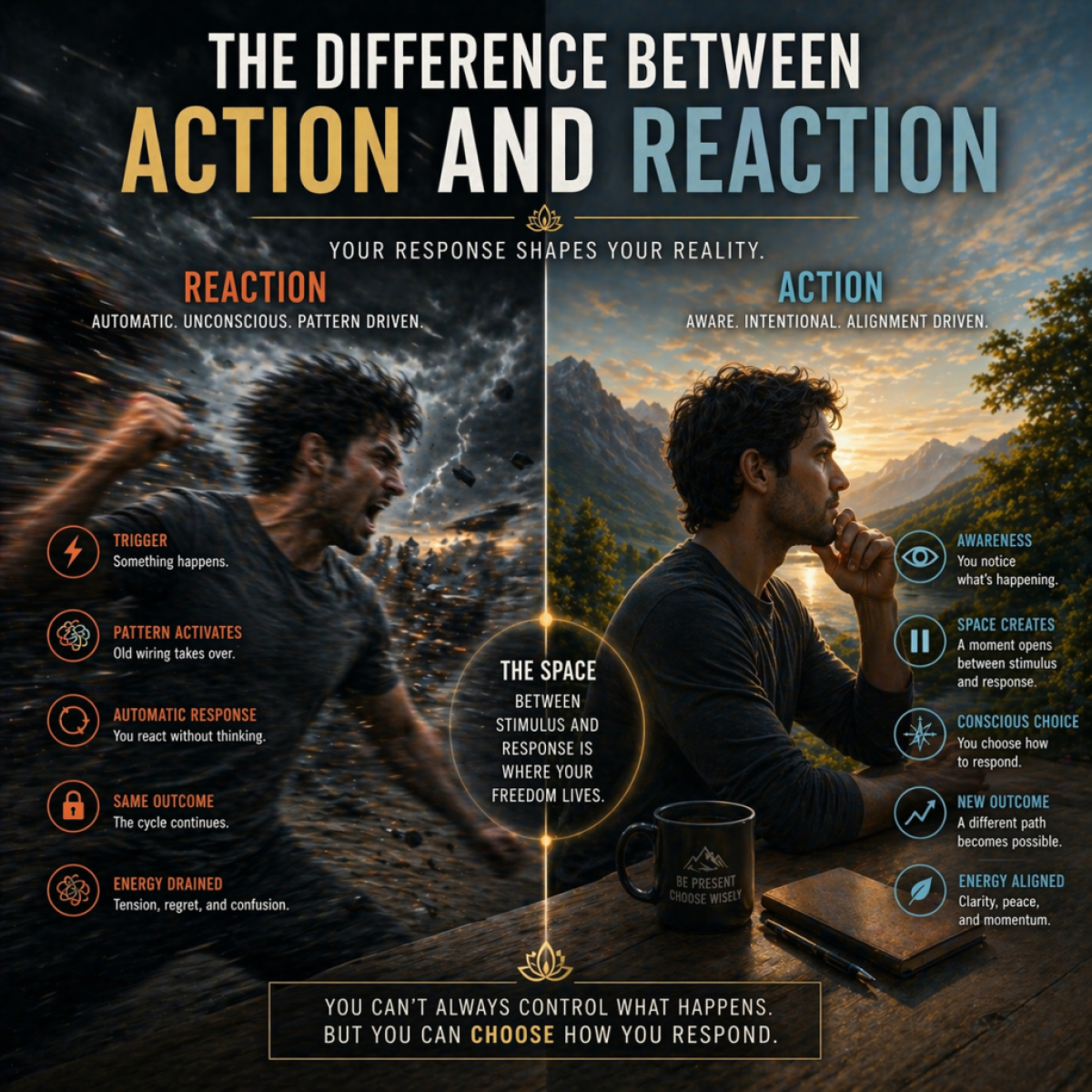
Most people think they are choosing how they respond.
But in many moments, what feels like a choice is actually a reaction.
It happens quickly.
Automatically.
Almost before you are aware of it.
What this feels like in real life
You respond… and then realize it after.
You say something… and wonder why you said it.
You react quickly… and only later think about it.
In those moments, it feels like you made a choice.
But look closely.
The response was already happening.
This is not a flaw.
It’s how patterns operate.
This builds directly on why awareness alone doesn’t create change and why forcing change creates resistance.
Here, we begin to see the difference between reacting to a pattern—and acting from alignment.
What a reaction is
A reaction is an automatic response.
It is driven by patterns that are already in place.
Something happens.
The pattern activates.
A response follows.
This can feel immediate— and unavoidable.
Because the process happens faster than conscious thought.
Reactions are often consistent.
They repeat in similar situations.
This is why certain experiences can feel predictable—even when you don’t intend them to be.
Why reactions feel like choices
Because reactions happen quickly, they often feel like decisions.
You may believe:
- “That’s just how I am”
- “That’s what I chose to do”
- “That’s the only way I could respond”
But in many cases, the response was already in motion before conscious awareness fully engaged.
This is one reason patterns can feel so stable.
Related: The Pattern Behind Every Limiting Belief You Have
What action is
Action is different.
It still results in behavior.
But it does not come from an automatic pattern.
It comes from a moment of clarity.
There is space between what happens and how you respond.
And in that space, something new becomes possible.
This is where action actually begins.
Where that space comes from
That space does not come from forcing control.
It comes from awareness combined with alignment.
When you are not pushing against a situation…
When you are not reacting automatically…
There is a brief opening.
And in that opening, perception is clearer.
Response is no longer predetermined.
This is where choice becomes real.
Why this can feel like “being in the zone”
In moments where action replaces reaction, something distinct is often noticeable.
There is less noise.
Less internal conflict.
Less hesitation.
Responses feel immediate—but not automatic.
Natural—but not forced.
This is similar to what many people describe as “being in the zone.”
Not because you are doing less.
But because nothing is interfering with what is happening.
How reaction keeps patterns in place
When reactions repeat, patterns remain stable.
The same trigger leads to the same response.
The same response leads to the same outcome.
This is how cycles continue.
Not through intention.
But through repetition.
Related: The Real Reason You Feel Stuck
How action creates change
When action replaces reaction, the sequence changes.
The trigger is the same.
But the response is different.
And because the response is different, the outcome begins to change.
This is where real movement happens.
Not by forcing new outcomes.
But by allowing a different response to emerge.
Why this matters
The difference between action and reaction is subtle.
But it changes everything.
Because it shifts where behavior is coming from.
From automatic pattern…
To present awareness.
Related: Why Alignment Feels Different Than Effort
Related: What Happens When You Stop Forcing Everything
And when that shift happens, the way you experience situations begins to change with it.
If something in this felt familiar…
This is where it changes →
Frequently Asked Questions
What is the difference between action and reaction?
A reaction is automatic and pattern-driven. Action comes from awareness and allows for new responses.
Why do I react automatically?
Because patterns operate below conscious awareness and activate quickly in familiar situations.
How do I move from reaction to action?
By creating space through awareness and reducing the pressure that reinforces automatic responses.
What does “being in the zone” mean?
It often describes a state where action flows naturally without internal resistance or overthinking.
If something in this felt familiar…
If you’ve ever reacted…
and only realized it afterward…
If you’ve noticed the same responses showing up…
even when you want something different…
This is why.
Because what feels like choice
is often a pattern already in motion.
And when that doesn’t change,
the outcome doesn’t change either.
And once that space appears, real choice begins.
Rob Mitchell is the creator of Manifesting Your Future, a transformational process designed to help people create real change through alignment of beliefs, values, and emotional patterns.


