
Why Awareness Alone Doesn’t Create Change
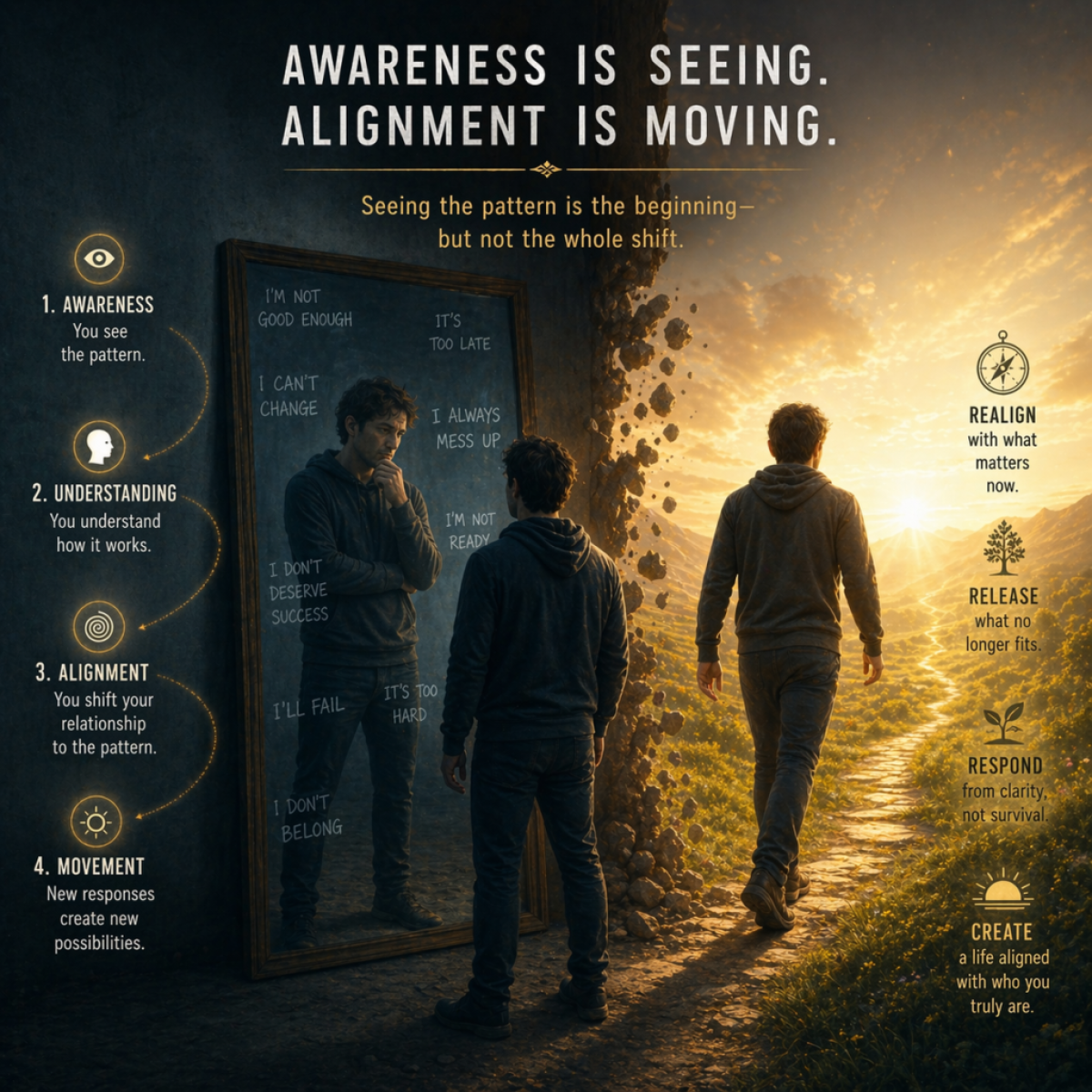
Alignment and presence are not things you force.
They are what begin to emerge when the way you see, interpret, and respond to life starts to change.
At some point, most people experience a moment of recognition.
They see a pattern they hadn’t noticed before.
They recognize a behavior that keeps repeating.
They suddenly understand something about themselves, a relationship, or a situation that had previously been hidden from view.
And for a moment, it feels like everything should change.
Because now they “see it.”
But then something unexpected happens.
The recognition is real, yet the pattern remains.
The same reactions appear.
The same situations feel familiar.
The same conclusions continue showing up, despite the fact that they are now visible.
This is where many people become frustrated.
Because they assume recognition should be enough.
But recognition alone does not always create change.
The deeper question is not whether something has become visible.
The deeper question is whether that recognition becomes trusted, participated in, and ultimately integrated into daily life.
This builds directly on why patterns can feel fixed and how beliefs are formed.
Here, we begin exploring why seeing something clearly does not automatically shift it — and why awareness, by itself, is often only the beginning.
What automatic programs are—and how they quietly shape your life
Have you ever driven across town, parked the car, and suddenly realized you don’t remember the drive at all?
Or found yourself doing something you’re exceptionally good at—so good, in fact, that you don’t have to think to do it?
What you’re experiencing in moments like these is the work of Automatic Programs (APs) running in your subconscious mind.
Automatic programs are not the enemy. In fact, without them, very little in life would function smoothly. They allow us to operate efficiently, elegantly, and often beautifully—without conscious effort.
But when an automatic program is misaligned with what you want now, it can quietly block progress, fulfillment, and emotional freedom.
This is one reason awareness alone is rarely enough to create real change.
The two minds, very different capabilities
Your rational (conscious) mind is extraordinary at what it was designed to do: planning, analyzing, reasoning, and making deliberate choices.
But conscious attention can only hold and process a limited number of variables at once.
This limitation isn’t a flaw. It’s a design feature.
Your subconscious (deep) mind, on the other hand, works very differently. It processes information in parallel, not in sequence. It simultaneously regulates emotion, memory, perception, physiology, and protective responses—all while keeping your body alive.
This is why a true partnership between the conscious and subconscious mind doesn’t just feel better—it functionally expands capacity.
When communication between these two systems is clear and aligned, you stop forcing change—and start allowing it.
What is an automatic program?
An automatic program is a learned pattern of perception, emotion, and behavior that runs below conscious awareness.
You install automatic programs every time you learn a skill:
- Riding a bike
- Driving a car
- Playing an instrument
- Speaking a language
At first, the conscious mind struggles. With repetition, the task is handed over to the subconscious—and suddenly it becomes smooth, fast, and even elegant.
This is the domain of professional athletes and master performers: the right automatic programs, running at the right time, without interference.
Without automatic programs, life would be nearly impossible.
When automatic programs work against you
Problems arise not because automatic programs exist—but because some were installed under conditions that no longer apply.
One of the most common ways dysfunctional automatic programs form is before the Age of Reason. A response that made perfect sense for a four-year-old can become deeply counterproductive for an adult—yet it continues to operate with full authority.
When this happens:
- You may get close to what you want… and something inexplicably stops you
- You may feel emotional reactions that make no sense in the moment
- You may experience sudden anger, fear, sadness, or withdrawal without knowing why
This isn’t self-sabotage—it’s protection.
It’s protection—based on outdated information.
And when the subconscious mind believes it is protecting you, it will not take orders from conscious intention alone.
Related: Why You Stay in Things You Know Aren’t Right
Why awareness feels like it should be enough
When something becomes clear, it changes how you think about it.
You can describe it.
You can recognize it.
You can even anticipate it.
And that creates the feeling that you are no longer inside it.
But in many cases, the pattern is still active.
Because awareness changes understanding first—not necessarily behavior.
What this looks like in real life
This is where it becomes confusing.
You can see the pattern clearly.
You can even predict it.
And then it happens anyway.
You react… and almost immediately recognize it.
You feel something… and know it doesn’t make sense.
You watch yourself do the very thing you said you wouldn’t do.
In those moments, it feels like you should be able to stop it.
But look closely.
The reaction is already in motion.
And the awareness shows up just after it.
That’s why awareness alone doesn’t change it.
Why awareness isn’t enough
Here’s the key insight:
You cannot reason your way out of a program that was never installed rationally.
Simply “knowing” what’s happening rarely changes it.
Automatic programs must be communicated with in the language they understand—which is experiential, emotional, and precise.
When approached correctly, clearing an outdated automatic program often takes minutes, not months or years. When cleared, the program doesn’t disappear—you own it. It becomes an ally rather than an obstacle.
This is where emotional freedom emerges naturally.
The difference between seeing and shifting
Seeing something creates space.
But shifting something requires something more.
Not more force.
Not more pressure.
But a different kind of relationship to what is being seen.
This is where many approaches break down.
Because they assume that once something is visible, it should immediately change.
But change does not always work that way.
Why effort alone often doesn’t work
When awareness doesn’t produce change, the next instinct is often effort.
Trying harder.
Pushing more.
Forcing a different outcome.
But if the underlying pattern is still organizing perception and response, effort can sometimes reinforce the same cycle.
This is one reason people can feel like they are “working on themselves” without seeing meaningful change.
Related: Why You Only See What You Already Believe
What happens when an automatic program is interrupted
When an automatic program is suddenly interrupted—without being cleared—it can cause abrupt changes in emotional state or awareness.
This is often at the core of eruptive anger, sudden fear responses, or emotional shutdowns.
The person experiencing this typically has no conscious explanation for what’s happening, which can be deeply distressing.
Handled correctly, these programs can be safely and efficiently resolved. Handled incorrectly, they can feel overwhelming or destabilizing—which is why method matters.
What actually begins to create change
If awareness alone is not enough, what makes the difference?
It begins with alignment.
Alignment is not force.
It is not pushing against something.
It is not trying to override what is happening.
It is a shift in how you relate to what you are seeing.
When perception begins to shift—not just intellectually, but experientially—the pattern itself starts to loosen.
And when the pattern loosens, new responses become available.
Why change often feels different than expected
Many people expect change to feel like effort.
Like control.
Like discipline.
But often, real change feels different.
It feels like something makes sense in a new way.
It feels like a pattern no longer has the same pull.
It feels like a response arises naturally instead of being forced.
This is why change can sometimes feel subtle at first.
Because it is happening at the level of perception—not just behavior.
Why this matters for everything else
Every pattern we’ve explored so far leads here.
Perception creates interpretation.
Interpretation creates meaning.
Meaning creates response.
Awareness allows you to see that process.
But alignment is what begins to shift it.
Related: The Real Reason You Feel Stuck
Related: The Pattern Behind Every Limiting Belief You Have
Once the relationship to the pattern changes, the pattern itself begins to change.
And that is where real movement begins.
Key takeaways
- Automatic programs operate below conscious awareness
- Some are essential; others quietly interfere with fulfillment
- Awareness alone rarely changes subconscious protection mechanisms
- Real change often begins when perception and response shift together
- Alignment creates the conditions for emotional freedom, presence, and meaningful transformation
When automatic programs are aligned with conscious intention, the mind functions as a unified system—not a divided one.
This internal partnership is foundational to recognition, self-trust, and the ability to participate consciously in your own experience.
Frequently Asked Questions
Why doesn’t awareness alone create change?
Awareness changes understanding, but many patterns continue operating below conscious awareness. Real change often requires a deeper shift in how those patterns are experienced and responded to.
What are automatic programs?
Automatic programs are learned patterns of perception, emotion, and behavior that run below conscious awareness. They help life function efficiently, but when outdated, they can interfere with what you want now.
Why do I still repeat patterns even when I see them?
Because patterns are not just thoughts. They often include emotional and behavioral responses that continue automatically until the underlying program begins to shift.
What creates real change?
Real change often comes from alignment—when perception, feeling, and response shift together in a way that allows a new pattern to emerge naturally.


