
Why Small Shifts Create Big Changes
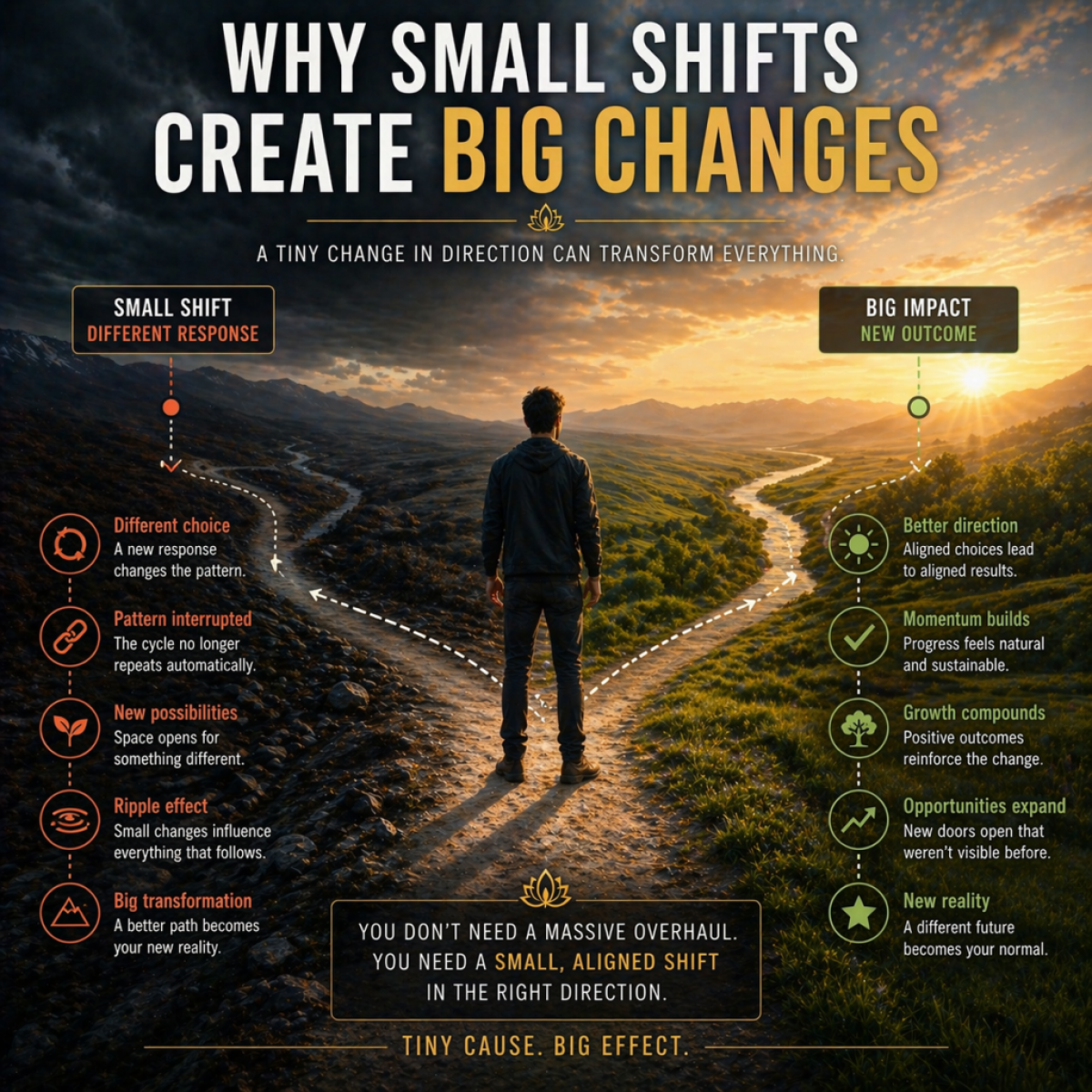
It doesn’t always take a big change to create a different outcome.
Sometimes, it takes something much smaller.
A slight shift in how you see something.
A subtle change in how you respond.
A moment where you don’t react the way you usually would.
And from that small shift, everything begins to move differently.
What this feels like in real life
You pause… instead of reacting.
You respond differently… even just slightly.
You notice the moment… and don’t follow the usual path.
In those moments, it can feel small.
Almost insignificant.
But look closely.
The pattern didn’t continue the same way.
This builds directly on the difference between action and reaction and what clarity actually feels like.
Because once a different response becomes possible, even briefly…
The entire pattern begins to change.
Why big effort isn’t always required
Many people assume that significant change requires significant effort.
That you have to do something drastic to get a different result.
But in many cases, the system you’re operating within is already stable.
It follows patterns.
Sequences.
Responses that repeat over time.
When that’s the case, even a small shift in the sequence can alter everything that follows.
How patterns amplify small changes
Patterns are not isolated events.
They’re chains.
One step leads to the next.
One response leads to another.
So when one part of the pattern changes—even slightly—the downstream effects begin to change as well.
This is why a small difference at the beginning can create a very different outcome later.
Why a different response changes the outcome
If a situation triggers the same response every time, the outcome will tend to repeat.
But if the response changes—even once—the pattern is interrupted.
And when the pattern is interrupted, something new can happen.
That new outcome can then become part of a different pattern.
This is how change builds.
Not always through force.
But through interruption and redirection.
Related: Why Forcing Change Doesn’t Work
Why subtle shifts are often more sustainable
Large changes can be difficult to maintain.
They often require continuous effort.
Continuous attention.
Continuous reinforcement.
Small shifts are different.
They don’t require the same level of force.
They adjust the system rather than trying to override it.
This makes them easier to sustain over time.
Why awareness makes small shifts possible
Without awareness, patterns run automatically.
There is no space to change them.
But once awareness is present, even briefly, a different response becomes available.
That moment may be small—but it’s enough.
But it is enough.
Because it creates an opening.
And in that opening, change begins.
Explore this topic further with The Emergent Mind
Why this connects to alignment
When a shift happens from alignment, it doesn’t feel forced.
It feels natural.
Almost obvious.
This is why aligned change often starts small.
It doesn’t need to be dramatic.
It just needs to be real and aligned.
Related: Why Alignment Feels Different Than Effort
Why this can feel surprisingly powerful
Because the shift is small, it’s easy to overlook.
But when you see the effect it creates, it becomes clear how much influence it has.
A slightly different response.
A slightly different perspective.
A slightly different decision.
And suddenly, the outcome is no longer the same.
This is how change compounds.
Why this matters
Many people are trying to change everything at once.
But in many cases, that’s not necessary.
What matters is where the change occurs.
Related: Why You Already Know More Than You Think
Related: What Happens When You Stop Forcing Everything
Because when it happens at the right point in the pattern, even a small shift can change everything that follows.
If something in this felt familiar…
This is where it changes →
Frequently Asked Questions
Why do small changes create big results?
Because patterns are sequential. A small change early in the sequence can affect everything that follows.
Do I need to make big changes to see results?
Not always. Small, aligned shifts can be more effective and sustainable.
What kind of shifts matter most?
Changes in perception and response often have the biggest impact on outcomes.
How do I create these shifts?
By becoming aware of patterns and allowing space for a different response to emerge.
If something in this felt familiar…
If you’ve ever made a small shift…
and noticed things begin to change…
If you’ve responded differently…
even once… and felt something open…
This is why.
Because change doesn’t always come from doing more—
it often comes from changing one part of the pattern.
And when that changes,
everything that follows begins to change with it.
And once the pattern shifts, the outcome follows.
Rob Mitchell is the creator of Manifesting Your Future, a transformational process designed to help people create real change through alignment of beliefs, values, and emotional patterns.


