Why Goals Alone Don’t Create Change

What’s the real difference between Manifesting Your Future and traditional goal setting?
This question matters.
Because many people have tried goal setting.
Many have tried positive thinking.
Many have tried to “just feel good.”
And when it didn’t work… they assumed it was their fault.
It’s not.
Let’s clarify why.
Traditional Goal Setting
Traditional goal setting generally works from the conscious mind.
You define a goal.
You visualize it.
You repeat affirmations.
You attempt to maintain a positive emotional state.
And yes — when someone genuinely feels aligned and emotionally clear, results often follow.
But here’s the issue:
Most people cannot “just feel good.”
Why?
Because they are not starting from a neutral baseline.
They are starting from pre-existing internal structures formed long before rational thought matured.
How Early Beliefs Form (Before Rational Thought)
Human rationality does not appear all at once.
Between ages 2–6, children are in what developmental psychology calls the preoperational stage. Thinking is intuitive, symbolic, emotional — but not yet logical.
Around age 7–8, the first stable rational faculty emerges. Children begin thinking logically about concrete situations. This period is often referred to as the “age of reason.”
Abstract, fully developed reasoning continues forming through early adolescence (11–15).
Here is the critical insight:
Most core beliefs about safety, worth, love, and possibility are formed before rational thinking fully develops.
At age 4 or 5, a child may conclude:
“I’m not good enough.”
“The world is unsafe.”
“Success causes conflict.”
“Love must be earned.”
These beliefs are not consciously chosen.
They are emotionally encoded.
And when rational thought later develops, it does not erase those early emotional structures.
It builds on top of them.
Where Traditional Goal Setting Struggles
By adulthood, a person may consciously decide:
“I want success.”
“I want abundance.”
“I want peace.”
But if implicit emotional schemas formed in early childhood conflict with that desire, the deeper system will override conscious intention.
This is not weakness.
This is neurobiology.
Early experiences are encoded in implicit memory systems — attachment patterns, emotional conditioning, and subconscious belief structures. These operate automatically and outside direct awareness.
So a person may affirm success consciously —
while emotionally bracing against it subconsciously.
This internal friction is what people call:
What this feels like in real life
This is usually where people get confused.
You want something clearly.
You’re motivated.
You’re doing the right things.
And something still resists.
You hesitate… without knowing why.
You lose momentum… even when you care.
You feel pulled forward and held back at the same time.
In those moments, it feels like something is wrong with you.
But look closely.
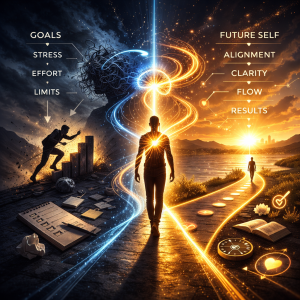
Two different directions are active at once.
And the effort you feel is coming from trying to override one with the other.
Emotional baggage
Limiting beliefs
Self-sabotage
But it is simply misalignment between conscious intention and earlier implicit programming.
The Difference That Makes the Difference
Traditional goal setting attempts to push forward from the conscious mind.
Manifesting Your Future works differently.
Instead of forcing new beliefs on top of old emotional structures, MYF teaches you how to:
Access earlier emotional imprints
Lift negative emotional charge
Resolve belief conflicts
Align values, emotions, and intention
When emotional maintenance stops consuming internal energy, that energy becomes available for creation.
You do not have to “try” to feel good.
You simply do.
Alignment is not manufactured.
It is uncovered.
What Happens When Alignment Occurs
When subconscious resistance clears:
Present moment awareness strengthens
Emotional regulation stabilizes
Internal conflict decreases
Action becomes natural instead of forced
You are no longer pushing a slab of concrete across the ground.
You are lifting it from beneath.
Effort decreases.
Clarity increases.
Momentum builds.
And the external world begins reflecting internal coherence.

Manifesting vs Goal Setting — In One Sentence
Traditional goal setting modifies conscious thought.
Traditional goal setting attempts to change conscious thought.
MYF focuses on reducing the interference that often prevents change from occurring naturally.
If you feel drawn to explore this further, that may not be random.
Recognition often first appears as intuition.
The question is whether it becomes trusted.
If something in this felt familiar…
If you’ve ever thought,
“I can see this clearly… so why does it keep happening?”
This is where most people get stuck.
Because awareness shows you the pattern—
but it doesn’t change it.
This is where it begins to change.
And it doesn’t take nearly as long as most people think.
Rob Mitchell is the founder of Manifesting Your Future and has spent decades helping people create meaningful change through recognition, emotional freedom, and the structures that shape human experience.
Frequently Asked Questions
Below are several common questions people ask about manifestation, traditional goal setting, and how internal alignment influences the results people experience.


