
Why Forcing Change Doesn’t Work
When something isn’t working, the instinct is often to change it.
And not just to change it—but to make it change.
To push it.
To control it.
To force a different outcome.
It feels logical.
If something is not the way you want it to be, applying force seems like the fastest way to make it different.
But in many cases, forcing change doesn’t work.
In fact, it can create the very resistance you’re trying to overcome.
What this feels like in real life
You try to make something change… and it tightens.
You push for a different outcome… and it resists.
You try to control how something unfolds… and it becomes more difficult.
In those moments, it feels like you just need more effort.
But look closely.
The pressure itself is part of what’s keeping it in place.
This builds directly on why trying harder can make things worse and why awareness alone isn’t enough.
Here, we begin to see why force itself can become part of the pattern.
Why force seems like the solution
Force is associated with control.
If you apply enough pressure, something should move.
This works in many physical systems.
But internal patterns—perception, emotion, behavior—do not always respond the same way.
They aren’t fixed objects.
They are dynamic processes.
And processes respond differently than objects.
What happens when you push against a pattern
When you try to force change internally, you are often pushing against something that is already active.
This can create tension.
That tension can lead to:
- Increased awareness of the problem
- Stronger emotional responses
- A greater sense of resistance
The more you push, the more the system reacts.
Not because it is broken.
But because it is responding to pressure.
Why resistance increases with force
Resistance is not always something that needs to be overcome.
Sometimes it is a response to how change is being approached.
When force is applied, the system often stabilizes itself.
It holds its current state more firmly.
This is why forcing change can feel like pushing against something that pushes back.
The more effort you apply, the more solid the resistance can feel.
Related: Why You Stay in Things You Know Aren’t Right
Why control can limit change
Control tries to direct outcomes.
It attempts to shape results by managing every part of the process.
But when dealing with complex internal patterns, control can narrow what is possible.
It focuses attention on what should happen—rather than what is actually happening.
This can prevent new responses from emerging.
Because everything is being filtered through a predefined outcome.
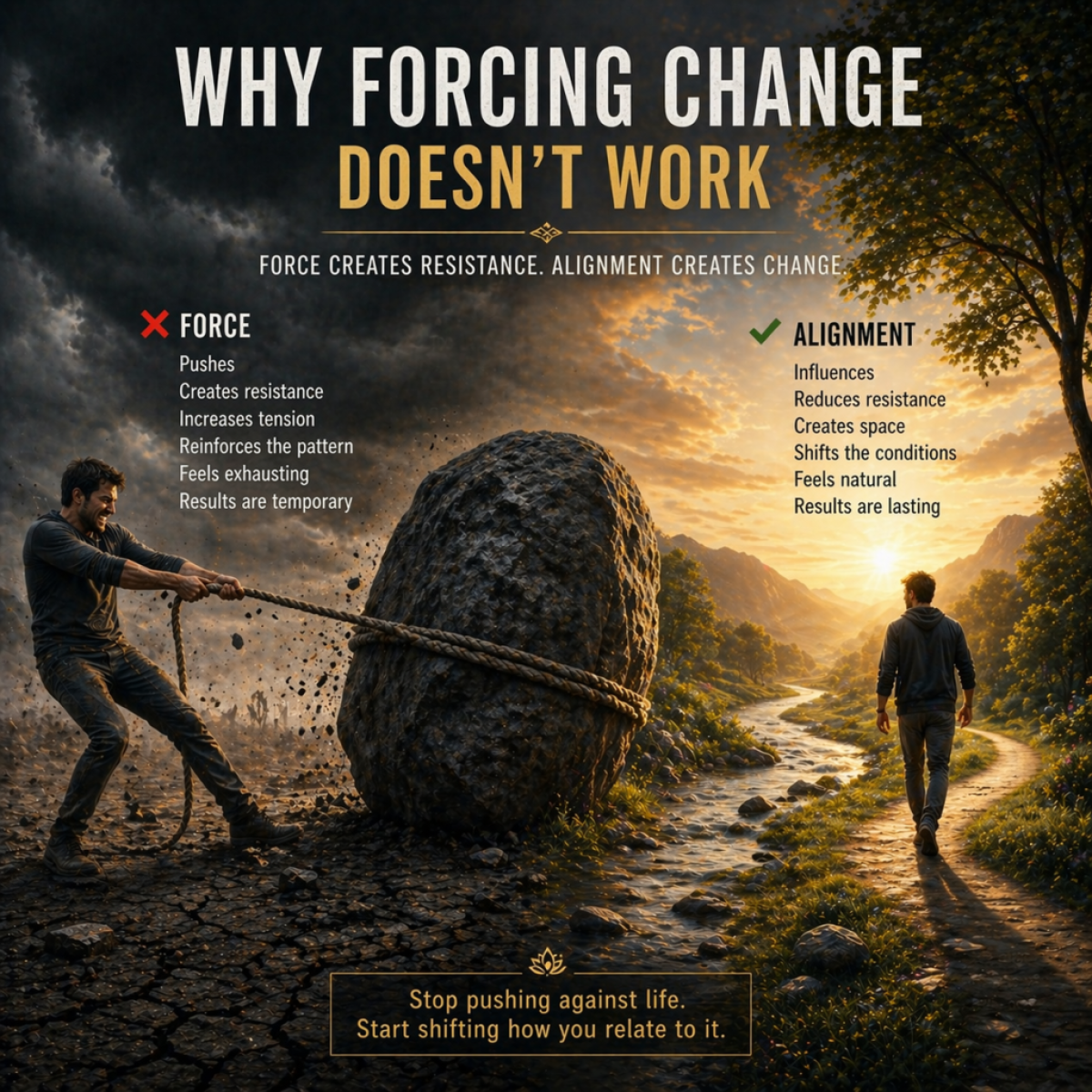
The difference between force and influence
Force pushes directly against something.
Influence changes the conditions around it.
This is an important distinction.
Because change often happens more effectively through influence than through force.
Instead of trying to override a pattern, you begin to shift how it operates.
You change how it is perceived.
You change how you respond to it.
And as those conditions change, the pattern itself begins to shift.
What happens when force is removed
When you stop forcing change, something unexpected often happens.
The intensity of the pattern begins to decrease.
Not immediately—
but gradually.
Because the pressure that was reinforcing it is no longer present.
This creates space.
And in that space, new responses can emerge.
Related: The Real Reason You Feel Stuck
Why real change feels different
When change is forced, it often feels tense.
Effortful.
Unstable.
When change happens through alignment, it feels different.
More natural.
More consistent.
Less like something you are holding together—and more like something that is holding itself.
This is because the underlying conditions have shifted.
Not just the surface behavior.
Why this matters for everything else
Many people believe that change requires force.
But in many areas of life, force can reinforce what you’re trying to change.
Understanding this distinction allows you to approach change differently.
Related: Why Trying Harder Often Makes Things Worse
Related: The Pattern Behind Every Limiting Belief You Have
And when the approach changes, the results often begin to change with it.
If something in this felt familiar…
This is where it changes →
Frequently Asked Questions
Why doesn’t forcing change work?
Forcing change can create resistance and tension, which may reinforce the pattern instead of resolving it.
What is resistance to change?
Resistance is often the system’s response to pressure. It can increase when force is applied.
What is the difference between force and alignment?
Force pushes against outcomes, while alignment changes the conditions that produce them.
How do I stop forcing change?
By shifting attention from controlling outcomes to observing how patterns operate and adjusting your relationship to them.
If something in this felt familiar…
If you’ve ever tried to force something to change…
and felt it push back…
If you’ve applied more effort…
and ended up with more resistance…
This is why.
Because force doesn’t change
what’s creating the pattern—
it often reinforces it.
And when that doesn’t change,
the outcome doesn’t change either.
And once the pressure drops, the pattern begins to loosen.
Rob Mitchell is the creator of Manifesting Your Future, a transformational process designed to help people create real change through alignment of beliefs, values, and emotional patterns.


