
What People Say Matters Most: The Missing Curriculum
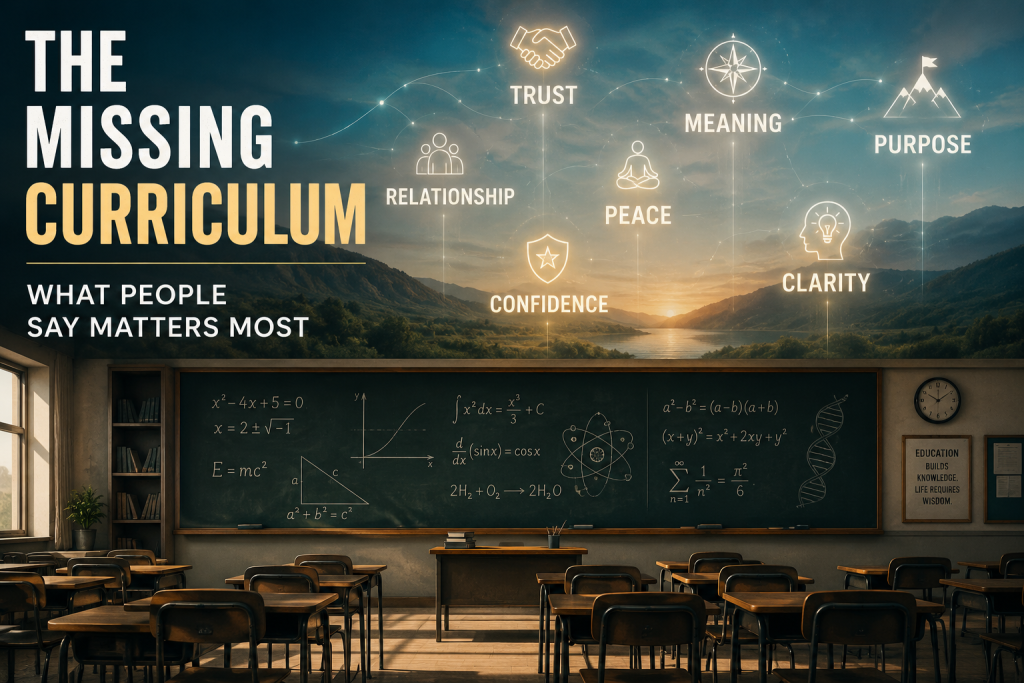
Ask people what matters most in life and the answers are usually not complicated.
They may use different words, but the pattern is remarkably consistent.
- Family
- Relationships
- Trust
- Health
- Purpose
- Meaning
- Peace
- Confidence
- Financial stability
- Emotional connection
- Being able to handle difficulty
Most people do not struggle to name what they value.
They know what matters.
The more interesting question is whether they were ever shown how to access it.
The Gap Between What Matters and What Is Taught
Standard education teaches many important things.
Reading matters. Writing matters. Math matters. Science matters. History matters. Physical health matters.
These are not small things.
But when people describe what they value most deeply, many of those things are not addressed directly, consistently, or practically.
| What People Often Say Matters Most | Usually Taught Directly? | The Gap |
|---|---|---|
| Healthy relationships | Rarely | People are often expected to figure out relationship patterns on their own. |
| Trust | Rarely | Trust is valued everywhere, but few people are taught how it forms, breaks, or returns. |
| Emotional safety | Rarely | People may learn rules for behavior without understanding the structures beneath emotional reaction. |
| Purpose and meaning | Rarely | People are often prepared to perform before they are helped to recognize what matters. |
| Inner peace | Rarely | Peace is usually treated as a personal goal, not a capacity that can be developed. |
| Confidence | Partially | People may be encouraged to believe in themselves without understanding what interferes with access. |
| Communication | Partially | Speaking and writing are taught, but deeper communication patterns are often left unexamined. |
| Financial stability | Inconsistently | Many people enter adult life without practical instruction in money, debt, risk, or decision-making. |
| Health | Partially | Physical health is commonly addressed, but the relationship between stress, perception, and behavior is often fragmented. |
This is not an attack on education.
Education was primarily designed to transfer information.
And information is useful.
But many of the things people value most are not only information problems.
They are access problems.
Information Is Not the Same as Access
A person can read books about relationships and still repeat the same relationship patterns.
A person can understand stress intellectually and still live inside constant stress.
A person can know communication techniques and still shut down, react, defend, or withdraw when something matters.
A person can believe happiness is important and still have no reliable way to recognize what keeps interrupting it.
This is where the distinction becomes important.
Knowing about something is not the same as having access to it.
Information can explain what something is.
Access changes what becomes available in lived experience.
What This Feels Like
For many people, this gap does not feel like a curriculum problem.
It feels personal.
It can feel like:
- “I know better, but I keep doing the same thing.”
- “I understand the issue, but I still react.”
- “I want peace, but my mind keeps looping.”
- “I value trust, but I do not know how to restore it.”
- “I want clarity, but everything feels complicated.”
- “I know what matters, but I cannot seem to live from it consistently.”
That is often where people begin blaming themselves.
But what if the problem is not that people do not care enough?
What if the problem is that many of the capacities required to live what they value were never developed directly?
The Missing Curriculum
The missing curriculum is not another subject added to a crowded schedule.
It is not simply more information.
It is the development of capacities that allow people to recognize and access what they already know is important.
Capacities like:
- Recognition
- Participation
- Relationship
- Trust
- Clarity
- Integration
These are not abstract ideas.
They shape how people experience decisions, relationships, conflict, pressure, disappointment, possibility, and change.
When recognition increases, repeating patterns become easier to see.
When participation changes, experience itself changes.
When trust develops, access expands.
When integration occurs, what was once only understood becomes lived.
Why This Matters
Most people already know that relationships matter.
They know health matters.
They know trust matters.
They know purpose matters.
They know peace matters.
The question is not whether these things are important.
The question is whether people have access to the inner structures that allow those things to become more available.
That is a very different question.
And once it is seen, many familiar struggles begin to look different.
Not as personal failure.
Not as lack of motivation.
Not as insufficient information.
But as a lack of direct access to the structures beneath experience.
Continue Exploring
If this distinction between information and access feels familiar, the following pages explore the deeper structure behind it:
- The Developing Mind explores how perception, interpretation, and conditioning begin shaping experience early in life.
- The Unencumbered Mind explores what becomes possible when interference decreases and direct access begins to return.
- The Emergent Mind explores how clarity, participation, and recognition can allow new possibilities to appear naturally.
Perhaps the most important things in life are not hidden.
People name them all the time.
Relationships.
Trust.
Meaning.
Peace.
Purpose.
Health.
Connection.
The deeper issue is not whether people value these things.
The deeper issue is whether they have been shown how to access them.
That may be the missing curriculum.
Frequently Asked Questions
What is the missing curriculum?
The missing curriculum refers to the capacities people need in order to access what they value most in life, such as trust, purpose, emotional connection, clarity, peace, resilience, and healthy relationships. These are often discussed as important, but they are rarely developed directly or systematically.
Why are healthy relationships rarely taught directly?
Healthy relationships are often assumed to develop naturally through family, friendships, or life experience. But many people are never shown how relationship patterns form, how trust is built, how emotional reactions shape communication, or how repeating patterns can be recognized and changed.
Why is trust difficult to teach?
Trust is difficult to teach because it is not only an idea or rule. It develops through lived experience, consistency, recognition, and relationship. People may understand that trust matters, but still not know how it forms, breaks, or becomes available again.
Why is emotional safety important?
Emotional safety affects how people communicate, respond to conflict, make decisions, and participate in relationships. Without emotional safety, people often become defensive, withdrawn, reactive, or confused, even when they intellectually understand what they want to do.
Why are purpose and meaning not usually taught in school?
Purpose and meaning are difficult to standardize because they emerge through personal recognition, experience, values, and participation. Education often prepares people to perform, achieve, and acquire information, but it does not always help people recognize what matters most to them.
Is inner peace something that can be developed?
Inner peace can develop when interference decreases and a person’s relationship to thought, emotion, and experience changes. It is not simply a mood or belief. It often emerges as clarity increases and internal conflict becomes easier to recognize.
Why do people know what matters but still struggle to live it?
Knowing what matters is not the same as having access to it. A person may value trust, peace, clarity, or connection, while still living through patterns that interrupt those experiences. This is why information alone is often not enough.
What is the difference between information and access?
Information explains something. Access changes what becomes available in lived experience. Someone may have information about communication, confidence, or relationships, but still lack access to the clarity or capacity needed to live those things consistently.
How does recognition help change repeating patterns?
Recognition makes hidden patterns visible. When a person begins to recognize the structure beneath a reaction, conflict, decision, or emotional loop, the relationship to that pattern can begin to change. What was automatic becomes more observable.
How does MYF approach the missing curriculum?
Manifesting Your Future explores the deeper structures beneath experience, including recognition, participation, relationship, trust, access, and integration. Rather than adding more information, MYF focuses on reducing interference so that what people already know is important can become more available in lived experience.

