

Why Explaining Something Isn’t the Same as Understanding It
A Quick Story
Years ago while teaching, I had a moment that completely changed how I understood learning.
I explained something that, to me, seemed perfectly clear.
I explained it again.
Still blank looks.
So I tried describing it differently.
Nothing.
Then suddenly one student said:
“Oh… I see it now.”
And instantly the entire room understood.
Nothing about the explanation had really changed.
But something inside the students had.
They didn’t just hear the description anymore.
They saw what it meant.
That moment illustrates something important about how human understanding actually works.
And it reminds me of an idea that goes all the way back to The Republic by Plato.
Plato’s Cave
In Plato’s story, people have lived their entire lives inside a cave.
They are chained so they can only look at the wall in front of them.
Behind them is a fire.
Between the fire and the prisoners, objects pass by, casting shadows on the cave wall.
The prisoners see the shadows…
…and assume that is reality.
Not a representation of reality.
Reality itself.
Then one day someone turns around.
He sees the fire.
Eventually he walks out of the cave and into the sunlight.
And suddenly realizes something profound:
What he once believed was reality was only a shadow of reality.
This story is known as Plato’s cave allegory, and it’s one of the most powerful explanations ever offered about how human perception works.
At its core, the allegory is about the difference between seeing something… and truly understanding what you are seeing.
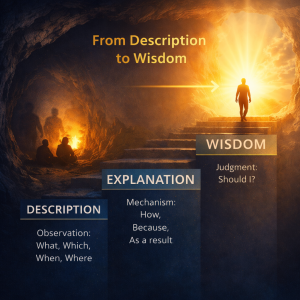
A description.
The First Level: Description
Description is simply what we observe.
It answers questions like:
- What happened
- Who was involved
- When it occurred
- Where it took place
In journalism these are called the 4 W’s.
What
Who
When
Where
Description gives us the surface of things.
Examples:
“The sky is blue.”
“He raised his voice during the conversation.”
“The meeting ended early.”
All useful.
But none of these tell us why.
They only describe what appears to be happening.
In fact, what we see is often not the full story at all.
As explored in What You See Is Not What Others See our minds constantly interpret and organize experience in ways that feel like reality — even when they are only partial views.
The Difference Between Description and Explanation
The Next Level: Explanation
Explanation asks a different question.
How.
Now we begin looking at causes and mechanisms.
Instead of saying:
“The sky is blue.”
We say:
“The sky appears blue because sunlight scatters in the atmosphere.”
Instead of saying:
“He raised his voice.”
We might ask:
“What caused the emotional reaction?”
Explanation connects observations into relationships.
This is where science does much of its work.
Philosopher Karl Popper argued that good explanations must be testable.
Philosophers of science such as Karl Popper emphasized that explanations must remain testable and open to revision.
If an explanation can never be proven wrong, it might not really explain anything.
It might simply be another shadow on the cave wall.
But Something Interesting Happens
Description and explanation can take us very far.
But eventually something strange happens.
They run out of road.
You can describe something perfectly.
You can explain every mechanism involved.
And still not truly understand it.
The Shift to Understanding
Understanding happens when the pieces suddenly connect.
Not just intellectually.
But internally.
You begin seeing patterns.
Relationships.
Meaning.
It’s the difference between learning music theory…
…and suddenly hearing the music.
Or reading about communication and relationships…
…and suddenly realizing why a certain conversation changed everything.
Understanding answers a deeper question:
Why does this matter?
And at this level something else begins to play an important role.
Imagination.
Where Imagination Enters
Up to description and explanation, rational thinking can do most of the work.
But once we start recognizing patterns and possibilities, something else joins the process.
Imagination.
Scientists imagine theories before they can prove them.
Musicians hear melodies before they exist.
Teachers often see understanding in a student before the student sees it themselves.
Logic works with what already exists.
Imagination explores what could exist.
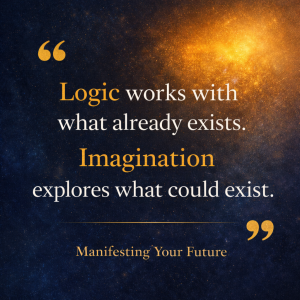
Insight often begins when logic and imagination begin working together.
This balance between intuitive and analytical thinking is part of what we explored in
How the Mind Works where the rational and intuitive parts of the mind operate almost like alternating currents of awareness.
The Limits of Description and Explanation
Description can tell you what happened.
Explanation can tell you how it happened.
But neither can fully answer questions like:
What does this mean?
What might happen next?
What action should I take?
For that we need another layer.
Knowledge and Wisdom
As descriptions and explanations accumulate, we begin building knowledge.
Patterns become clearer.
Ideas form systems.
But knowledge alone still isn’t enough.
Because knowledge must be applied.
It must be interpreted.
It must be guided by judgment.
That is where wisdom enters.
Wisdom asks questions like:
Is this the right moment?
Is this the right action?
Is this aligned with what truly matters?
Wisdom recognizes something very important (This is closely related to what we explored in The Core of the MYF Process):
Every explanation has limits.
Every theory eventually breaks.
Reality is always larger than our models.
And Then Something Even Deeper
When the prisoner leaves the cave and finally sees the sun, the meaning of Plato’s allegory becomes clear.
He doesn’t simply gain new information.
His way of seeing reality changes.
Insights begin appearing almost instantly.
Not through step-by-step logic.
But through direct perception.
Many people call this intuition.
Some call it inspiration.
Others simply call it wisdom.
Whatever the name, it’s the moment when the mind stops staring at shadows…
…and begins seeing reality more clearly.
Why This Matters
Most of the time we live in the lower levels.
We argue about descriptions.
We debate explanations.
But real growth begins when we move beyond them.
When we begin asking deeper questions.
When we become willing to turn around in the cave.
Because the moment we do…
the shadows begin to look very different.
A Simple Reflection
The next time you encounter a problem or disagreement, ask yourself:
Am I looking at a description?
An explanation?
Or something deeper?
Sometimes the biggest shift in life begins with a simple realization:
You might still be looking at shadows on the cave wall.
But we can make it slightly more experiential.
The next time you find yourself in a disagreement or trying to understand a difficult situation, pause for a moment and ask:
Am I looking at a description?
An explanation?
Or something deeper?
Because sometimes the biggest shift in life begins with a simple realization.
You might not be seeing reality clearly yet.
You might still be looking at shadows on the cave wall.
Turning around in the cave is sometimes the beginning of wisdom.
Continue Exploring
If this idea resonates, you may also enjoy:
• How the Mind Works
• What You See Is Not What Others See
• How to Become Fully Present and Why It Changes Everything
Reference
The discussion of the cave is inspired by The Republic by Plato, in which the allegory of the cave is used to illustrate the difference between appearance and reality and the process of gaining deeper understanding.
The distinctions between description, explanation, understanding, knowledge, and wisdom reflect broader traditions in philosophy, education, and epistemology, but the framework presented here represents a practical synthesis used in the Manifesting Your Future work.
If something in this post felt familiar…
If you’ve ever thought, “I can see this clearly… so why does it keep happening?”
This is where most people get stuck.
Because awareness shows you the pattern—
but it doesn’t change it.
Rob Mitchell is the creator of Manifesting Your Future, a transformational process designed to help people create real change through alignment of beliefs, values, and emotional patterns.
Frequently Asked Questions
Below are several common questions people ask about the difference between explaining something and truly understanding it.