
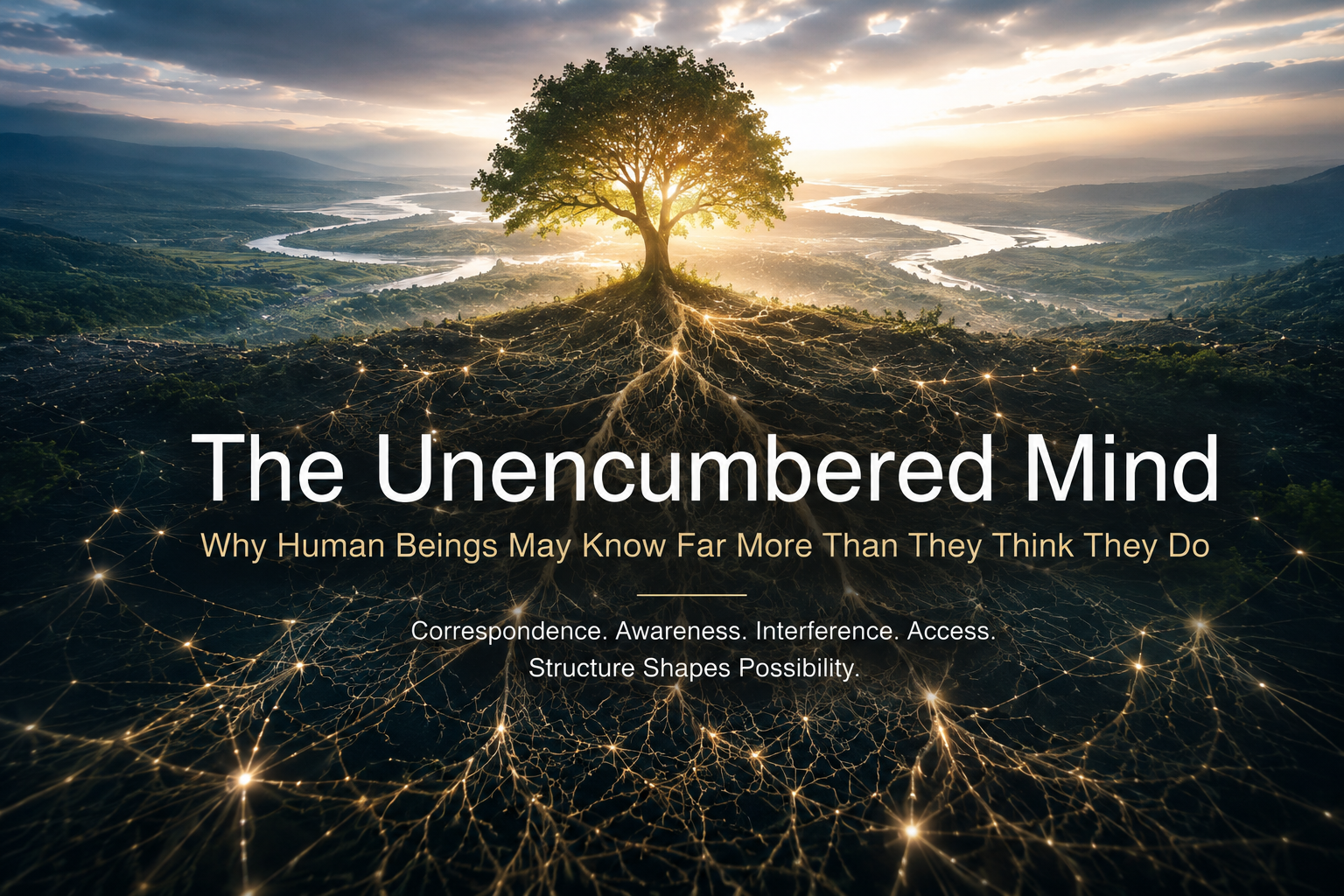
The Unencumbered Mind
Why Human Beings May Know Far More Than They Think They Do
Most people think they are rational.
In fact, human beings are correspondence-recognition systems that exhibit rational explanation afterward.
The rational mind mostly explains what deeper processes already:
- recognized
- selected
- reacted to
- feared
- avoided
- desired
- or knew
Afterward, it creates a story explaining why.
That is the modern human condition.
Part I: Correspondence, Interference & Access
Correspondence
You have never seen two clouds exactly alike.
Yet you instantly recognize clouds.
How?
Not through memorization.
Not through logic.
Not through exact comparison.
You recognize structural continuity beneath changing appearance.
That is correspondence.
And without it, you know nothing.
- No science
- No intuition
- No pattern recognition
- No abstraction
- No meaning
- No learning
- No identity
- No language
- No understanding
Nothing.
Because without correspondence, reality becomes disconnected fragments with no continuity between them.
Recognition Comes First
A child can recognize an object rotated in any direction after seeing it once.
Why?
Because the child does not store pixels.
The deeper system extracts structure.
The rational mind arrives later and calls the structure:
- chair
- tree
- mother
- danger
- love
The name is not the knowing.
Recognition comes first.
Explanation comes later.
Knowledge Emerges From Within
Human beings are taught that knowledge comes from outside themselves.
Correspondence Theory proposes almost the exact opposite.
The deepest knowing emerges from within through:
- correspondence
- structure
- context
- recognition
- and access
This is why one correct metaphor can reorganize a human being instantly while years of explanation may accomplish little.
The metaphor transfers structure.
Recognition occurs internally.
The person suddenly realizes something they somehow already knew.
Not because information was inserted.
Because something recognized itself.
What Cells Know
Cells perform actions of astonishing sophistication continuously.
They:
- repair tissue
- replicate accurately
- organize into organs
- regulate growth
- communicate chemically
- coordinate immune response
- adapt to changing conditions
Yet cells do not:
- explain
- theorize
- memorize concepts
- claim ownership
- or describe what they are doing
They simply participate in organization.
This raises an uncomfortable question:
If cells can perform functions rational humans cannot consciously explain or reproduce, then what exactly is knowing?
Modern culture often equates knowing with:
- stored information
- explanation
- memory
- symbolic reasoning
But living systems suggest something else entirely.
Knowing may exist as:
- direct organizational capacity
- relational intelligence
- structural responsiveness
- contextual emergence
without requiring conscious explanation at all.
A cell does not remember how to heal tissue the way a human remembers a phone number.
The capacity appears structurally available.
Which suggests something important:
Memory and knowing may not be the same thing.
The Mind as a Dynamic Access System
The mind may function less like a storage device and more like a dynamic access system.
The degree of interference within the system influences the degree of access available to it.
This changes almost everything.
Because under this model, negative emotions, limiting beliefs, internal contradiction, defensive identity structures, conflicting values, and chronic psychological tension are not merely emotional problems.
They are interference patterns.
They reduce access.
The Encumbered and Unencumbered Mind
An encumbered mind tends toward:
- force
- explanation
- local thinking
- rigid categorization
- compulsive control
- symbolic repetition
An unencumbered mind is more able to:
- access
- receive
- integrate
- synthesize
- recognize
- allow emergence
The difference may not primarily be intelligence.
It may be interference.
How Emergence Happens
This may be why insight so often appears:
- in dreams
- during meditation
- after intense struggle
- upon waking
- in moments of silence
- while walking
- during contemplation
- or immediately after letting go
The emergence was already forming beneath conscious awareness.
Resistance decreased.
Access increased.
The knowing surfaced.
Structure Determines Possibility
Modern culture trains people to think mechanically and locally.
But nature does not organize locally.
Nature organizes relationally.
A storm emerges from distributed atmospheric conditions.
A forest emerges from interacting ecological systems.
Chlorophyll — literally a specific arrangement of atoms — converts sunlight into biological energy.
The structure changes what becomes possible.
That may be one of the deepest principles in reality:
Structure determines possibility.
Change Occurs Through Reorganization
The implications are staggering.
Because if structure determines possibility, then:
- suffering may be structural
- healing may be structural
- identity may be structural
- limitation may be structural
- perception may be structural
- society may be structural
- intelligence itself may be structural
Which means change does not primarily occur through force.
It occurs through reorganization.
Direct Knowing
Human beings suffer partly because they are separated from trust in their own direct knowing.
Modern systems reinforce this separation constantly:
- education
- media
- institutional authority
- fragmented specialization
- social conditioning
- rigid rationalism
People are taught:
- what to think
- what to repeat
- what to memorize
- what to obey
but rarely how to recognize.
Why This Can Feel Threatening
This is why people defend broken systems so aggressively.
Because the moment a human being realizes:
- awareness changes access
- meaning is participatory
- reality is relational
- direct knowing exists
- consciousness is not merely passive
the old worldview begins collapsing immediately.
That is terrifying at first.
Because then responsibility returns.
Agency returns.
Participation returns.
And the person realizes they may have been living inside inherited structures mistaken for reality itself.
The Rational Mind Is Not King
The rational mind is an incredible tool.
It is not king.
It is:
- translator
- organizer
- serializer
- explainer
The deeper system moves first.
The rational mind narrates afterward.
That is why people:
- know before they know why
- sense danger instantly
- feel truth before explanation
- recognize patterns immediately
- trust or distrust before reasoning
- experience intuition
- suddenly “see” things all at once
Correspondence occurs first.
Explanation comes later.
Transformation and Recognition
The deepest transformations do not happen because somebody inserts truth into another person.
They happen because:
- resistance decreases
- defenses soften
- context changes
- trust emerges
- interference reduces
- structure reorganizes
- recognition occurs
The facilitator does not install knowing.
The facilitator creates conditions in which latent knowing can emerge safely enough to be recognized.
Once You See Correspondence
Most people are not actually afraid of failure.
They may be afraid of recognizing how much participation, perception, and knowing they may already possess.
Because once someone truly sees correspondence, they begin seeing it everywhere.
And after that, the world never looks the same again.
Discover How it Works, or continue to part II below…
Part II: Implications for Humanity
The implications of this model extend far beyond individual psychology.
Because if human experience is shaped structurally, and if interference influences access, then many of the systems organizing modern civilization may need to be reconsidered entirely.
Not through ideology.
Not through force.
But through deeper understanding of how structure shapes:
- perception
- behavior
- cognition
- learning
- health
- conflict
- creativity
- institutions
- and human possibility itself
Systems & Civilization
Modern civilization increasingly optimizes for:
- speed
- efficiency
- control
- categorization
- specialization
- stimulation
- information accumulation
Yet many human beings simultaneously report:
- fragmentation
- anxiety
- burnout
- disconnection
- meaninglessness
- chronic stress
- emotional exhaustion
- loss of direction
This may not be accidental.
A system organized around fragmentation often produces fragmented human experience.
An encumbered civilization may naturally generate encumbered minds.
Because systems do not merely contain behavior.
They organize it.
If structure shapes possibility, then the structure of civilization itself influences what becomes psychologically, emotionally, and socially accessible.
Education & Recognition-Based Learning
Modern education often emphasizes:
- memorization
- repetition
- categorization
- isolated subjects
- symbolic performance
- procedural correctness
But human understanding may emerge more through:
- recognition
- correspondence
- contextual emergence
- structural transfer
- relational thinking
- synthesis
- metaphor
- deep pattern recognition
Meaning: education may function best not when it merely transfers information, but when it creates conditions in which recognition becomes possible.
A student who truly understands something often experiences recognition before explanation.
The explanation arrives afterward.
That changes the purpose of learning itself.
Education may become less about storing information and more about developing access.
Healthcare & Human Organization
Modern healthcare systems are often fragmented.
One specialist addresses symptoms.
Another addresses chemistry.
Another addresses behavior.
Another addresses emotional state.
Yet human beings do not exist as disconnected categories.
They exist as integrated systems.
A structural model increasingly asks:
- What organization is producing this repeatedly?
- What emotional patterns reinforce it?
- What relational dynamics sustain it?
- What unresolved contradictions exist beneath it?
- What environmental structures contribute to it?
- What chronic stress patterns are shaping the nervous system?
This does not eliminate biology.
It contextualizes biology within larger relational systems.
Health may be less mechanical than modern systems assume.
And more ecological.
Conflict & Human Behavior
Most conflicts are treated as:
- isolated disagreements
- ideological differences
- moral failures
- personality defects
But many conflicts may emerge structurally.
Identity structures become threatened.
Emotional patterns become activated.
Feedback loops reinforce escalation.
Defensive systems organize behavior automatically.
People often believe they are reacting to the present moment while actually reacting to accumulated organizational patterns beneath conscious awareness.
This applies to:
- marriages
- workplaces
- politics
- institutions
- social media
- international conflict
A structural understanding does not eliminate accountability.
But it radically deepens understanding.
And systems built from deeper understanding often become:
- less punitive
- less reactive
- more adaptive
- more preventative
- more humane
Ecology & Relational Thinking
Modern systems often solve locally while destabilizing globally.
Nature does not appear to organize that way.
A forest is relational.
An ecosystem is relational.
The atmosphere is relational.
The ocean is relational.
No single location contains the storm.
The organization exists across relationships.
Many environmental crises may partially emerge from local optimization disconnected from larger coherence.
Structural thinking naturally asks:
- What secondary effects emerge?
- What hidden dependencies exist?
- What adaptive responses occur?
- What feedback loops become activated?
- What unseen relationships sustain the larger system?
This changes sustainability entirely.
Because sustainability may ultimately be a question of relational coherence.
Creativity, Intelligence & Human Potential
Highly integrative cognition may underlie much of what humanity calls:
- genius
- creativity
- intuition
- invention
- insight
- innovation
- strategic vision
The ability to recognize structural continuity across domains may be one of the deepest forms of intelligence.
Yet many modern systems suppress this capacity through:
- hyper-specialization
- rigid categorization
- excessive proceduralization
- chronic stress
- emotional interference
- fear-based performance structures
A highly encumbered mind often narrows into:
- repetition
- rigidity
- force
- local thinking
- symbolic management
An unencumbered mind becomes more capable of:
- synthesis
- emergence
- relational thinking
- creative transfer
- pattern recognition
- contextual insight
The difference may not primarily be raw intelligence.
It may be access.
Human Agency & Degrees of Freedom
Possibly the most important implication is this:
Human beings may possess far more participation in their experience than modern systems comfortably acknowledge.
Not through magical control.
Not through fantasy.
But through the relationship between:
- awareness
- perception
- emotion
- identity
- meaning
- structure
- and access
Once people recognize that recurring patterns are not random, they may begin:
- observing more carefully
- recognizing patterns earlier
- reorganizing consciously
- becoming less reactive
- increasing coherence
- reducing interference
That expands degrees of freedom.
And once a person begins seeing correspondence clearly, they often begin seeing it everywhere.
The Future of Human Development
Human development may not primarily depend on accumulating more information.
It may increasingly depend on reducing interference to access.
The future may belong less to the most informed minds and more to the least encumbered ones.
Because an unencumbered mind is more capable of:
- clarity
- recognition
- relational understanding
- emotional flexibility
- direct knowing
- integration
- coherent participation within larger systems
If true, this changes not only how human beings understand themselves.
It changes how civilization understands possibility itself.
Continue Into the Process
If this framework resonates, the next step is not to adopt another belief.
It is to begin seeing how interference, structure, and access may be operating in your own experience.